
Andrzej Novák

Andrzej Novák

I study the properties of the Higgs boson at the Large Hadron Collider, mainly its coupling to charm quarks. I showed that AI agents can already carry out complete particle-physics analyses almost unaided; now I am measuring how well they do it, and making them better.

Postdoctoral Associate in the Phil Harris Lab, MIT Laboratory for Nuclear Science
Junior Investigator, NSF AI Institute for Artificial Intelligence and Fundamental Interactions (IAIFI)
CMS Experiment, CERN

Research directions

  • Establish the Higgs boson’s coupling to charm quarks.
  • Build the tools for AI agents to carry out physics analyses.
  • Benchmark agentic performance on High Energy Physics tasks.
  • Make analyses end-to-end differentiable, and therefore fully optimisable.

For questions or collaborations, please get in touch.

MIT Laboratory for Nuclear Science IAIFI Phil Harris Lab at MIT The CMS Experiment at CERN

Education

  1. Johns Hopkins UniversityBS in physics, MA in physics and astronomy
  2. RWTH Aachen UniversityPhD, 2024
  3. MITPostdoctoral Associate

Research and methods

Research

Higgs and new bosons decaying to quarks, at the LHC with CMS.

Research 1 · Higgs and charm

Can the LHC see the Higgs boson decay to charm quarks?

The Higgs boson couples to each quark in proportion to its mass. The coupling has been measured for the heavy third-generation quarks, top and bottom; charm would be the first second-generation quark. It is hard because the Higgs decays to charm about 20 times less often than to bottom, and because quarks appear in the detector as jets, sprays of particles, and jets from charm quarks look much like those from bottom or light quarks.

The programme

When will the LHC see H→cc? I made the projection shown in the Higgs plenary talk at the 2026 International Conference on High Energy Physics (ICHEP). Scaled to the full dataset of the upgraded High-Luminosity LHC, the published analyses alone reach a significance of about 1.8σ; the improvements already demonstrated, new triggers (the real-time selection of which collisions to keep) that catch more charm events and better charm identification, bring that to about 2.3σ. This programme aims to close the remaining gap to 3σ, the threshold for evidence: the next generation of charm taggers, triggers that bring more of each channel’s events into the analysis, and combining ATLAS with CMS.

From 2024 to 2026 I convened the CMS group for Higgs decays to bottom and charm quarks, which covers these analyses.

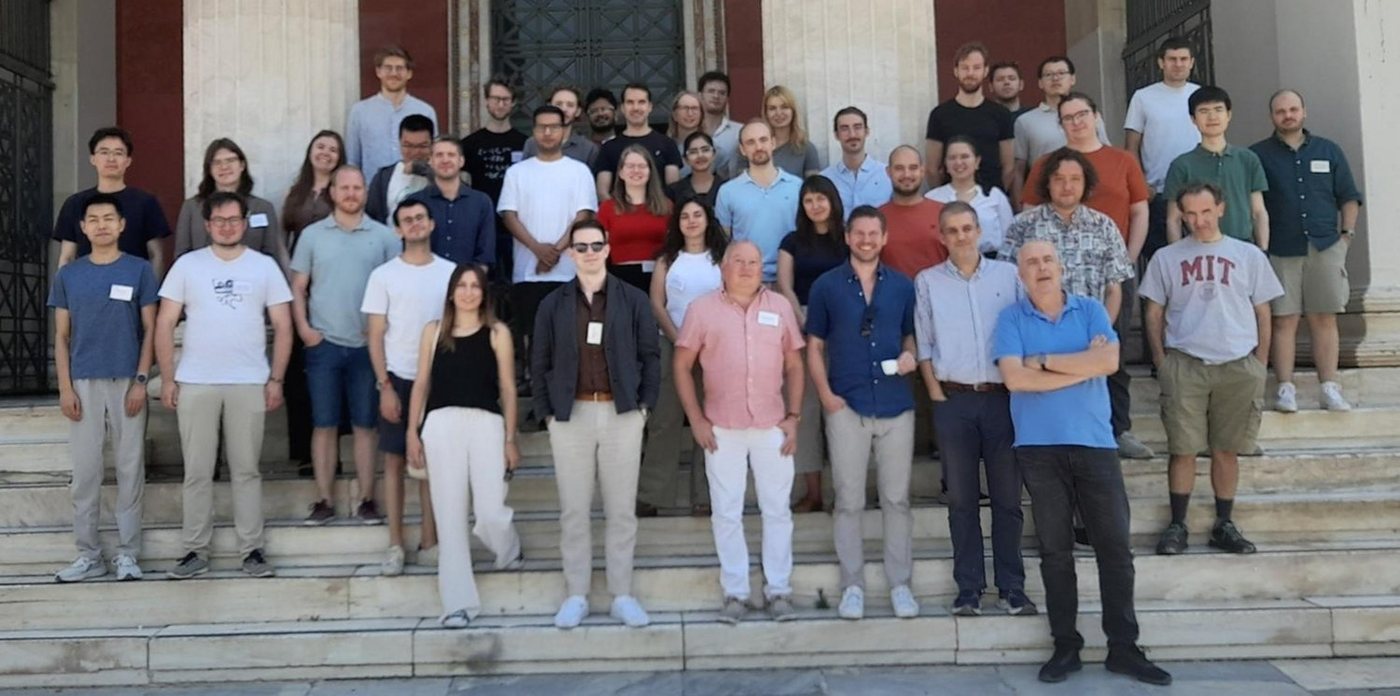
Join the effort. The (CMS) Higgs/Charm Workshop brings together researchers working on charm in the Higgs sector. I started the series at MIT in 2024; the second edition was in Athens in 2026.
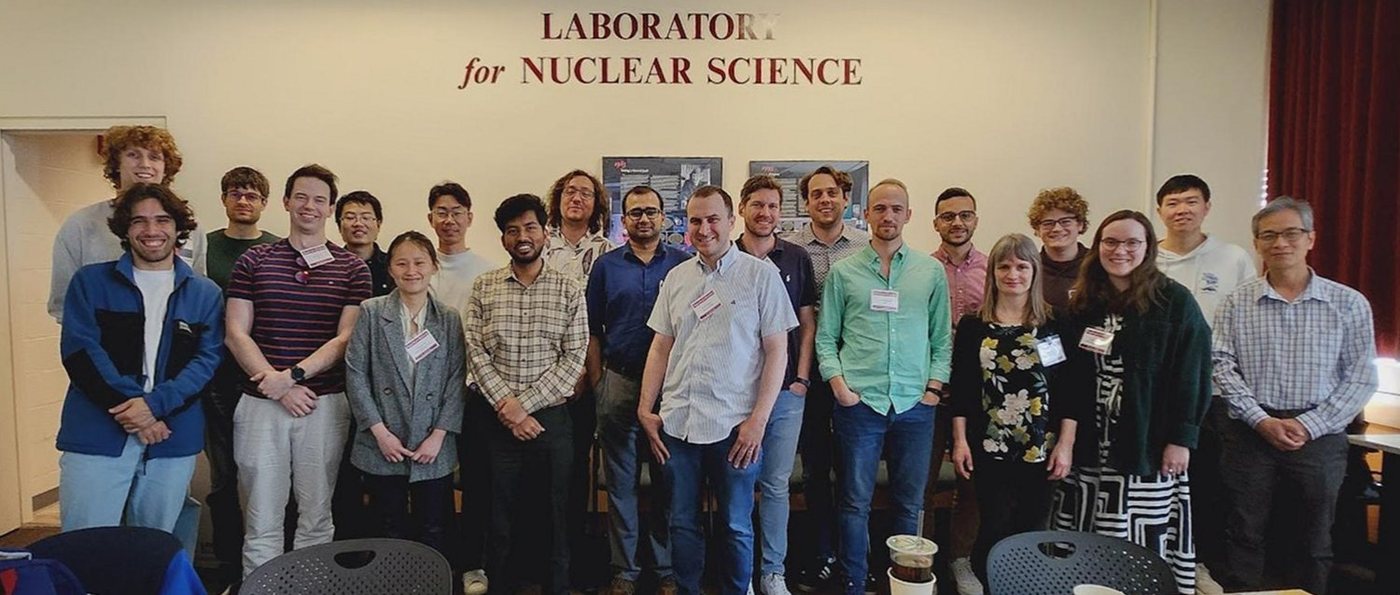
Group photo of the participants of the 1st CMS Higgs/Charm Workshop at the MIT Laboratory for Nuclear Science, May 2024.
MIT, May 2024
Group photo of the participants of the 2nd CMS Higgs/Charm Workshop on the steps of a building in Athens, June 2026.
Athens, June 2026
Projected H to charm discovery significance and the 95% CL upper limit on the charm Yukawa modifier versus integrated luminosity, for several systematics scenarios and successive analysis improvements, up to the HL-LHC.
CMS Simulation Preliminary · ICHEP 2026, Higgs highlights · full size

My thesis

For my PhD I built DeepDoubleX, the CMS classifier described under jet identification, which recognises jets from a Higgs or Z boson decaying to a pair of bottom or charm quarks, and calibrated it on real data. With it I performed the first search for H→cc in high-momentum ("boosted") Higgs bosons. The same analysis gave the first observation of the Z boson decaying to charm quarks at a hadron collider; it remains the most precise measurement of that decay at the LHC.

CMS jet mass distribution in charm-tagged jets with a clear Z to charm peak near 90 GeV.
CMS, PRL 131 (2023) 041801 · arXiv:2211.14181 · full size

Uses jet identification · plotted with mplhep

Research 2 · Boosted resonance searches

A Higgs or a new particle in a single jet

When a heavy boson (a Higgs, W, Z or something new) is produced with high momentum, the two quarks it decays to are so collimated that they merge into a single wide jet with two cores. Such jets are vastly outnumbered by ordinary jets from the strong interaction (QCD), so finding them takes dedicated classifiers and a careful fit to the jet’s mass, which peaks at the mass of the parent boson.

Boosted VH(bb)

This is the most sensitive measurement of high-momentum Higgs bosons decaying to bottom quarks (H→bb) produced together with a W or Z boson, in the channel where every boson decays to quarks. Built on the analysis methods and boosted-jet techniques of my thesis search, it asks a different question: not which quarks the Higgs couples to, but how it behaves at high momentum. High momentum is where new physics would show: heavy particles too massive to produce directly would still modify the Higgs boson’s couplings, and the effect grows with energy, bending the tail of the Higgs momentum spectrum away from the Standard Model. That tail is exactly where this measurement is most sensitive, so it constrains such couplings directly.

VH(bb) event, sketched

CMS jet mass distribution of the Higgs candidate jet in the b-tagged pass region, with the Z boson decaying to a bottom quark pair and the VH contribution.
CMS, PLB 879 (2026) 140534 · arXiv:2601.05362 · full size

Dark-matter mediators

A light new boson that couples to quarks, such as a mediator between ordinary matter and dark matter, would show up in the same jets as a bump in the jet mass. Turning the same boosted-jet techniques to new particles, I drove a search for two kinds of such boson: a vector coupling equally to all quarks, and a scalar coupling to quarks in proportion to their mass, as the Higgs does (the “minimal flavour violation” pattern), which at these masses means mainly to bottom quarks. Our limits on how strongly such a boson can couple to quarks are the strongest to date between 50 and 250 GeV, up to three times stronger than the previous best.

Mentorship

Z′→qq event, sketched

CMS jet mass spectrum in the signal region, with the W and Z peaks, top quark and QCD backgrounds, and two Z-prime signal hypotheses.
CMS, submitted to PRL · arXiv:2603.21965 · full size
CMS summary of limits on the coupling of a leptophobic Z-prime boson to quarks versus its mass; the boosted dijet search EXO-24-007 in green improves on the previous CMS boosted dijet result between 50 and 250 GeV, other searches in grey.
This search (green) vs the previous CMS result (pale green); other searches greyed. CMS Preliminary, July 2024 · CMS summary plots · full size

Uses jet identification · next: differentiable analysis

Methods

AI agents, benchmarking, differentiable analysis and jet identification: the methods behind the measurements above.

Methods 1 · AI agents

Can an AI agent do a physics analysis, and how would we know?

Just Furnish Context

In Just Furnish Context I gave AI coding agents open-ended access to a computer and to public data from three particle-physics experiments: ALEPH and DELPHI at LEP (CERN’s previous collider), and CMS. They carried out about ten complete analyses, from strategy to written-up result, each in about ten hours. A complete draft in a day, roughly a first-year graduate student’s first three months of work: not yet publishable, but every step in place. One of them, the primary Lund jet plane in ALEPH data (a map of how a jet’s energy is shared among its successive splittings), had never been measured in electron–positron collisions before.

Paper
Talks
Mentorship
Agent-produced measurements of Z lineshape, Rb, AFB, alpha_s and a Higgs signal strength compared with published values.
AI agents vs published values · arXiv:2603.20179 · full size
Lund jet plane density measured by an AI agent in archival ALEPH data.
ALEPH Lund plane, measured by an agent · arXiv:2603.20179 · full size
Just Furnish Context

How the agents work

An illustrative walkthrough of the workflow I built · source: arXiv:2603.20179

  • The measurementHiggs decays to tau leptons (H→ττ) in CMS Open Data at 8 TeV
  • A written reportreviewed at every phase; a human approved the unblinding
  • A git repositoryone reproducible task per step, every step committed · project page
  1. Objective measure H→ττ production in CMS Open Data at 8 TeV
  2. Coordinating agent hands every phase to a worker agent and runs none itself
  3. 1 · Strategy the method and a plan for the uncertainties · reviewed
  4. 2 · Exploration check the data, find the useful variables · self-reviewed
  5. 3 · Selection choose the collisions and correct for the detector · reviewed
  6. 4a–b · Fit and check estimate the expected sensitivity with the real data hidden, then validate on 10% of the data · reviewed
  7. Human approval a person approves looking at all the data; here, you do
  8. 4c · Measure the measurement on all the data · reviewed
  9. 5 · Documentation final figures and the written report · reviewed

Next: benchmarking

Methods 2 · Benchmarking

How do you grade an AI analysis?

The open problem is evaluation: a way to grade science produced by agents that scales and is hard to game. I am building benchmarks that score agent-produced analyses against answers the agents never see: an agent develops its analysis on one public dataset, then its frozen pipeline runs on many sealed ones with hidden true values, and is scored both on the numbers it reports and on the quality of the analysis behind them, relative to an expert analysis.

Paper
Talk and poster
Mentorship
Benchmark scheme: an AI agent develops an analysis on one public dataset and hands in a frozen pipeline; the pipeline is rerun on many sealed datasets with different hidden true values, and an evaluator scores precision, pull and bias, goodness of fit and compute against an expert reference analysis.
Develop on one public dataset, be scored on many sealed ones · arXiv:2611.28194 · full size
Leaderboard11 models on 4 tasks
  1. 1Gemini 4 ArgonAntigravity60%
  2. 2GPT 6 AstraCodex38%
  3. 3Gemini 4 HydrogenAntigravity36%
  4. 4Claude Opus 5.5Claude Code31%
  5. 7DeepSeek V4.1 FlashOpenCode5.8%
050expert 100%
Top four models and the best of each family: mean score as a percentage of the expert analysis · live from the benchmark leaderboard
How the score is computed: move the sliders or drag the dots and the score follows · from the benchmark page
Methods 3 · Differentiable analysis

Differentiable analysis

I am building Doppio (Differentiable Optimization for Pair Peak Identification), a package in JAX that makes the whole analysis differentiable. A collider analysis is usually a chain of separately tuned steps: a classifier, a selection, then a statistical fit. Hard cuts and histogram bins have no useful gradient, so Doppio replaces them with smooth weights and differentiates through the fit itself. All three steps are then optimised together and trained unsupervised, with no labels, directly on the statistical significance of the result. The differentiable fit at its core was first published as Split-N-Fit.

Paper and talk
Mentorship

Next up: boosted resonance searches

A toy Doppio fit: selection, classifier and fit trained together · source: CHEP 2026 talk · NeurIPS ML4PS 2025 · paper in preparation

Methods 4 · Jet identification

Which quarks made this jet?

Every bottom- and charm-quark measurement above depends on telling jets from a b or c quark pair apart from ordinary jets. Hadrons containing b or c quarks live about a picosecond and fly a few millimetres before decaying, so their tracks start from a secondary, displaced vertex: the signature the classifier looks for. I designed DeepDoubleX, the CMS neural network that identifies such jets, trained it so that it does not distort ("sculpt") the jet-mass distribution the fit relies on, and improved how such classifiers are calibrated on real data. I introduced adversarial training to CMS jet tagging, to make taggers robust to detector mismodelling; CMS now trains its production taggers (UParT) that way. From 2019 to 2021 I convened the CMS group developing these algorithms.

Mentorship

Used in H→cc · boosted H→bb · new light bosons

An H→cc jet in the CMS transverse view, down to the displaced vertices the tagger looks for · source: illustration, not data; the tagger: CMS-DP-2022-041

Difference between disturbed and raw AUC versus raw AUC for a b-versus-light jet tagger, one point per training epoch: open markers for nominal training fall steeply as performance rises, filled markers for adversarial training stay nearly flat, for FGSM distortions with epsilon 0.02 and 0.05.
The better a conventional tagger gets, the more fragile it becomes under distorted inputs (open markers); adversarial training (filled) removes most of that fragility. One point per training epoch · Comput. Softw. Big Sci. 6 (2022) 15 · full size

Selected publications

As a member of the CMS Collaboration I am an author on 600+ of its published papers. Listed here are the ones I contributed to directly.

  1. HEP-Ex-Bench: Evaluating Agentic Performance in High Energy Physics Experiment Data Analyses with Sealed WorldsA. Novák*, Y. Zhao*, D. Garcia, E. A. Moreno, J. Krupa, V. Bresó-Pla, S. Bright-Thonney, L. Heinrich, M. Kagan, P. Harris, arXiv:2611.28194 (2026) · *lead authors · benchmark page
  2. AI agents can already autonomously perform experimental high energy physicsE. A. Moreno*, S. Bright-Thonney*, A. Novák*, D. Garcia, Y. Zhao, P. Harris, arXiv:2603.20179 (2026) · *equal contribution
  3. Search for a boosted Higgs boson decaying to bb in association with a W or Z bosonCMS Collaboration, Phys. Lett. B 879 (2026) 140534
  4. Search for low mass vector and scalar resonances decaying into quark-antiquark pairsCMS Collaboration, arXiv:2603.21965, submitted to Phys. Rev. Lett.
  5. AutoSciDACT: automated scientific discovery through contrastive embedding and hypothesis testingS. Bright-Thonney, C. Reissel, G. Grosso, N. Woodward, K. Govorkova, A. Novák, S. E. Park, E. Moreno, P. Harris, NeurIPS (2025), arXiv:2510.21935
  6. Split-N-Fit: a differentiable maximum-likelihood fit for training neural networks and performing anomaly detection on dataP. Harris, A. Novák, NeurIPS Machine Learning and the Physical Sciences workshop (2025)
  7. Search for boosted Higgs bosons produced via vector boson fusion in the H→bb decay modeCMS Collaboration, JHEP 12 (2024) 035
  8. Inclusive search for a boosted Higgs boson and an observation of the Z boson decaying to a charm quark pairCMS Collaboration, Phys. Rev. Lett. 131 (2023) 041801 · PhD thesis
  9. Performance of heavy-flavour jet identification in boosted topologiesCMS Collaboration, CMS-PAS-BTV-22-001 (2023)
  10. Performance of the mass-decorrelated DeepDoubleX classifier for double-b and double-c large-radius jetsCMS Collaboration, CMS-DP-2022-041 (2022)
  11. Improving robustness of jet tagging algorithms with adversarial trainingA. Stein, X. Coubez, S. Mondal, A. Novák, A. Schmidt, Comput. Softw. Big Sci. 6 (2022) 15
  12. Simulation of dielectric axion haloscopes with deep neural networks: a proof-of-principleP. A. Jung, B. Ary dos Santos, D. Bergermann, T. Graulich, M. Lohmann, A. Novák, E. Öz, A. Riahinia, A. Schmidt, Comput. Softw. Big Sci. 6 (2022) 18
  13. Inclusive search for highly boosted Higgs bosons decaying to bottom quark-antiquark pairsCMS Collaboration, JHEP 12 (2020) 085
  14. A search for the standard model Higgs boson decaying to charm quarksCMS Collaboration, JHEP 03 (2020) 131
  15. Performance of deep tagging algorithms for boosted double quark jet topology with the Phase-0 CMS detectorCMS Collaboration, CMS-DP-2018-046 (2018)

All publications: INSPIRE · Google Scholar

Open source

Analysis software

  • mplhepPlotting for particle physics on top of matplotlib. I created it in 2019 and still lead it.~390k downloads a month · 222 ★ on GitHub · default style of ATLAS and CMS
  • coffeaFast, array-based analysis of large particle-physics datasets. As an early developer I built its visualisation and scale-out and shaped its early API.146 ★ on GitHub
  • scikit-hepThe Python ecosystem for particle physics: hist, uproot, vector, mplhep and more.organisation admin and contributor

2023–2024 As CMS Data Processing Tools convener I set the strategy for the collaboration's analysis software and coordinated its development.

A histogram drawn with mplhep in the CMS style, from the mplhep documentation.
One histogram in each experiment's mplhep style, and in matplotlib's default · source: mplhep documentation

Mentorship

Graduate and undergraduate students I have mentored day to day on the research above, at MIT and at RWTH Aachen.

Current

MIT, graduated

RWTH Aachen

I also mentored four B.Sc. students through their theses at RWTH Aachen.

Teaching

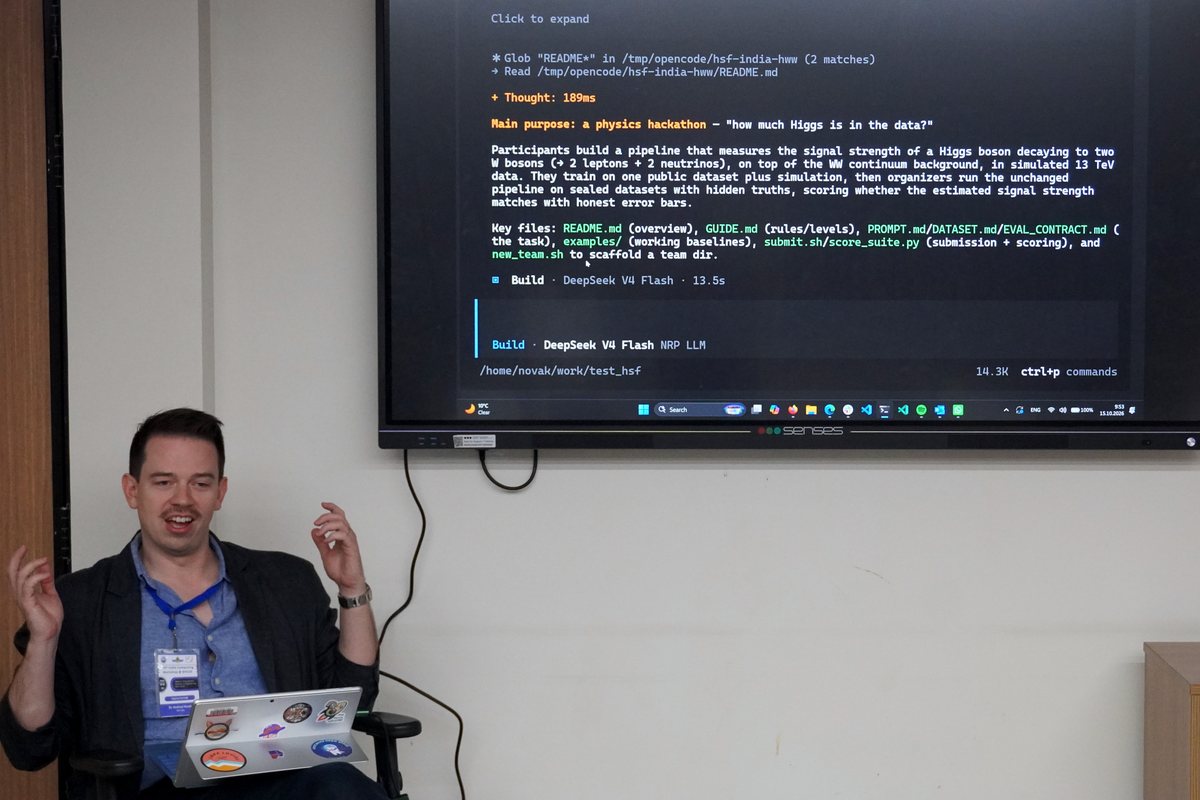
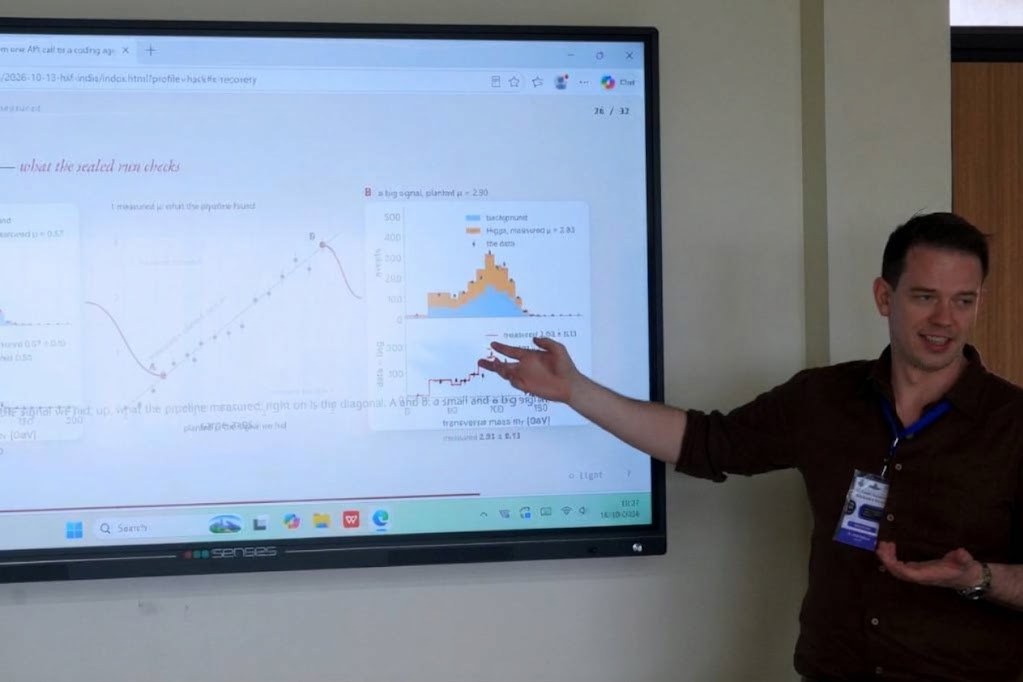
At the HSF-India Scientific Computing Workshop (HEP Software Foundation) in New Delhi (October 2026) I taught From one API call to a coding agent and ran a hackathon in which teams built a Higgs measurement with coding agents, scored on sealed datasets with hidden truths.

Andrzej Novák demonstrating a coding agent reading the hackathon repository, its answer on the screen behind him.
A coding agent reads the hackathon brief, live
Andrzej Novák presenting the hackathon results, pointing at a plot of planted versus measured Higgs signal strength.
The next day: planted versus measured signal strength

Courses and tutorials

  • 2026HSF-India Scientific Computing Workshop, New Delhi. Lectures on coding agents and a hackathon.
  • 2026CLARIPHY meeting, Madison. Tutorial: AI agents and LLMs for scientific discovery (with D. Diaz) · slides
  • 2024US CMS / IRIS-HEP analysis software training, Princeton. Data visualisation techniques and libraries.
  • 2021IRIS-HEP Analysis Grand Challenge tools workshop. Histogramming and visualisation.
  • 2019–2021PyHEP. mplhep tutorials.
  • 2018–2019RWTH Aachen. Tutor, advanced laboratory course in particle physics.
  • 2015–2017Johns Hopkins. Teaching assistant, General Physics Laboratory I and II.

Lectures and outreach

  • 2026CMS masterclass on agentic analysis, for students and postdocs in the collaboration · slides
  • 2026CERN International Masterclasses. Moderator.
  • 2019, 2026Public lectures on research at the LHC (Prague; Vsetín).
  • since 2017Discover Summer Academy. Tutor and coordinator at a summer camp for talented high-school students.

Service

CMS is a collaboration of about 4,000 scientists; conveners lead its physics and software groups.

  • 2024–2026Convener, CMS Higgs → bb/cc group. Set the publication strategy and coordinated 25+ researchers; reviewed 15+ results through to publication.
  • 2023–2024Convener, CMS Data Processing Tools. Strategy for the collaboration’s analysis software, workshops and hackathons, and a colour-blind-friendly colour scheme for CMS results.
  • 2019–2021Convener, CMS Flavour Identification Software and Algorithms. Development of new machine-learning algorithms for identifying b and c jets.
  • 2024, 2026Started and organised the (CMS) Higgs/Charm Workshop. MIT, 2024 · Athens, 2026
  • 2026International organising committee, CMS–ATLAS Flavour Tagging Workshop, Florence.
  • 2025–2026Member, IAIFI Talent Forum board.
  • 2025–2026Member, IAIFI speaker selection committee.

Two 6.8 TeV beams meet in CMS.

Where the two lines meet next. Analyses optimised end to end for the measurement they target, and agent-made results that can be checked as rigorously as our own.